

Century-Old "Spectral Ghost" Paradox Resolved
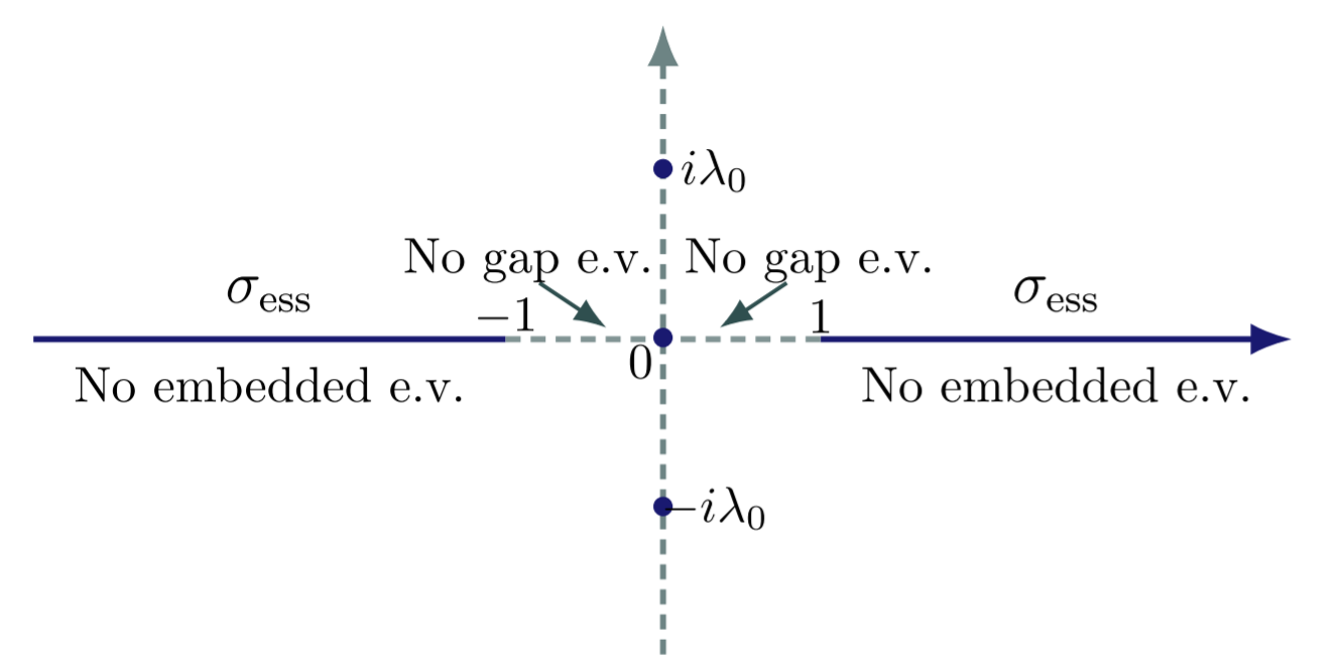
Illustration of the spectrum
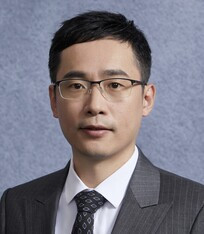
Prof. Dong Li
In a landmark achievement, a research team led by Prof. Dong Li, Chair Professor in the Department of Mathematics at HKU, has resolved a long-standing mathematical paradox known as the spectral ghost in nonlinear dispersive equations. This breakthrough, published in the prestigious, peer-reviewed academic journal that publishes original research papers across all fields of mathematics, Inventiones mathematicae, carries profound implications for both fundamental science and societal advancement.
Dispersive equations, fundamental to modelling wave phenomena across physics, engineering, and applied sciences, have historically posed complex challenges, especially when nonlinear effects lead to unpredictable behaviours. The "spectral ghost" paradox, rooted in theoretical possibilities identified by von Neumann and Wigner in 1929, refers to mysterious embedded eigenvalues—hidden energy traps within a continuous spectrum that hinder accurate analysis and prediction of wave dynamics. For decades, mathematicians struggled to fully understand and overcome this obstacle.
Prof. Dong Li’s innovative research employs advanced analytical techniques to reveal the true nature of these spectral anomalies. His findings not only eliminate the paradox but also provide the definitive analytical cornerstone for proving asymptotic stability, establishing a rigorous mathematical framework for understanding wave interactions in nonlinear systems. This breakthrough enhances the mathematical toolkit available for studying complex physical processes, from quantum mechanics to climate modelling.
The significance of this discovery extends beyond pure mathematics, fostering vital knowledge exchange across disciplines. By bridging abstract mathematical theory with practical scientific applications, it encourages collaboration among mathematicians, physicists, and engineers worldwide. This interdisciplinary approach accelerates the development of more accurate models for natural phenomena, ultimately informing technological innovations and policy decisions.
Societally, the implications are substantial. An improved understanding of wave behaviour influences the design of advanced communication systems, seismic analysis, and medical imaging technologies. Furthermore, it deepens our comprehension of natural systems, contributing to better environmental management and disaster prediction.
Prof. Dong Li’s achievement exemplifies how fundamental research can catalyse societal progress by expanding scientific horizons and enabling technological advancements. It underscores the importance of knowledge exchange across fields, driving innovations that benefit society-at-large.