

Discover the Ecological Devices Revolutionising San Tin Wetlands and Its Social Impact
San Tin’s fishponds at Hong Kong’s border with Mainland China embody more than an aquaculture industry—they are living cultural heritage and ecological habitats shaped by generations of practice.
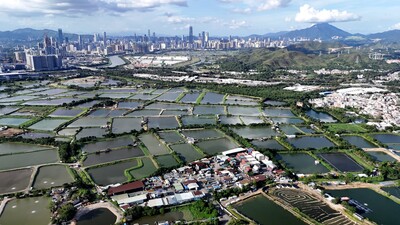
Yet rapid regional development and the ageing of fishpond operators raise urgent questions: can wetland conservation and future growth coexist, and can these landscapes be experienced by the public without harming the wildlife they sustain?
A team from HKU, led by Prof. Joshua Bolchover of the Faculty of Architecture, is piloting the Ecological Devices project at the Deep Bay Wetlands. The initiative investigates how design interventions can enhance sustainability in traditional fish-farming practices while converting the ponds into accessible public spaces for education, observation, and community involvement. The team aims to balance maintaining fish farming viability with transforming the landscape into an engaging environment for the public.
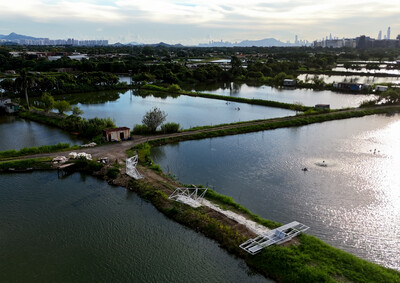
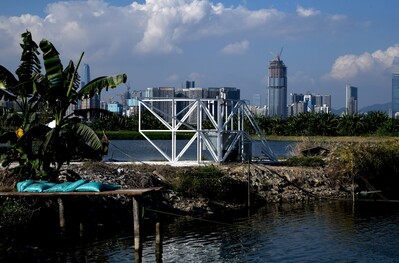
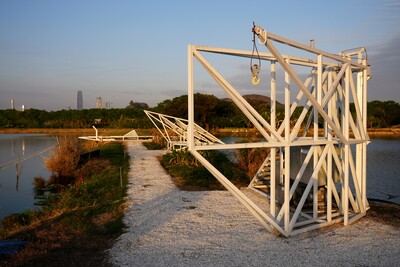
The project developed and installed three ecological devices to reduce labour, harness solar energy, and support pond ecology. Together, they form an integrated “synthetic landscape” that blends human use with ecological function—where pumps, reeds, and migratory birds can continue to thrive alongside modern infrastructure.
First, the Crane uses a manually operated jib hoist that extends over the water, rotating through 240 degrees and lifting up to 0.5 tonnes to assist with harvesting. It also includes a viewing stair, enabling operators and visitors to observe the ponds directly, turning everyday work into an educational encounter with wetland processes.
Second, the Hide and Feeder combines solar-powered automated pellet feeding with solar panels mounted over a shaded bench. This reduces reliance on bread-based feeding, which is nutritionally inferior for birds and prone to mould. By improving feed practice, the system can reduce growing time by 20–25%, while the shaded bench supports rest for operators and bird-watching for visitors.
Third, the Pump Deck spans two ponds, using solar panels to power pumps that transfer water and aerators that add oxygen—supporting fish health and wetland stability through less energy-intensive, more reliable operations.
Crucially, the devices also serve as a knowledge-exchange platform. They demonstrate how heritage aquaculture can evolve through experimentation with energy production, water amelioration, and visitor-facing design. The project provides operators with practical tools while inviting the wider public to understand the ecological value of fishpond wetlands beyond their economic role.
In social terms, the benefits extend to sustainability and dignity: reduced labour for ageing operators, improved ecological outcomes for migratory birds, and new ways for communities to learn from and participate in wetland stewardship. As Hong Kong plans for future development, these ecological devices offer a model for co-producing environmental value—where innovation strengthens both biodiversity and community connection.